Research on New Way to Build Safer, More Sustainable Skyscrapers
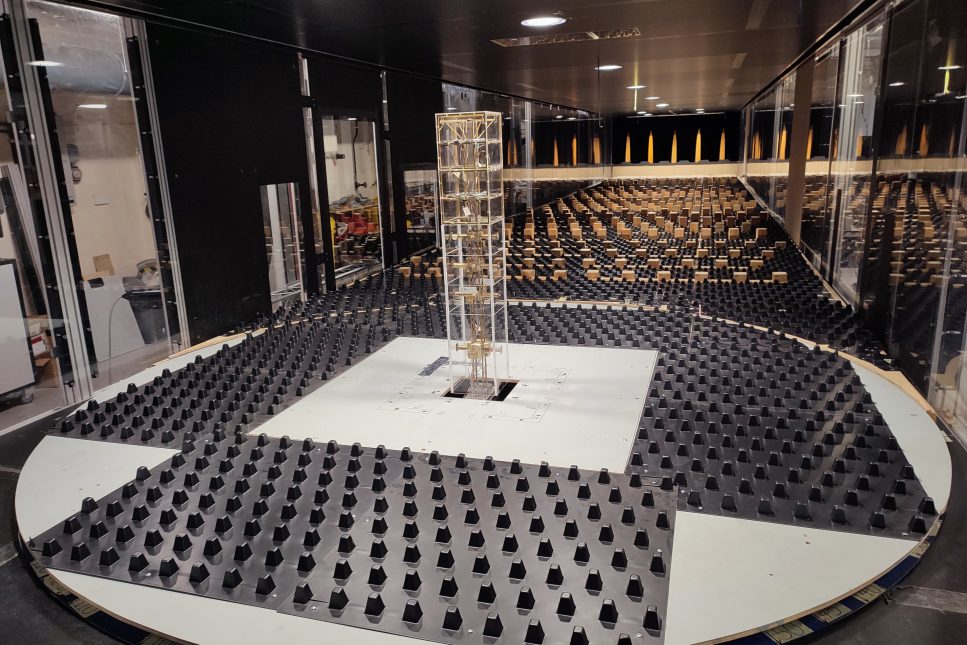
The National Wind Tunnel Facility’s 10ft x 5ft wind tunnel at Imperial College London has been used in research to test a new approach to designing safer, more resilient and more sustainable tall buildings.
The research was led by Miguel Martínez Pañeda (Department of Civil and Environmental Engineering and Arup), with Professor Ahmed Y Elghazouli (Department of Civil and Environmental Engineering) working alongside Dr Kevin Gouder (Department of Aeronautics) and industry colleague Dr William Algaard (Arup).
Inspired by traditional Japanese pagodas, the researchers developed an approach that uses a building’s own mass to reduce movement in high winds and earthquakes. Instead of trying to eliminate movement, it accepts that buildings will move and puts that movement to work to improve the building’s performance. Their solution separates a group of usable floors near the top of the building from its central core, connecting them with springs and dampers so that the floors can move slightly and independently, using their own weight to absorb energy and control the building’s motion.
The results showed the system dramatically reduced how much the building moved, with peak wind-induced accelerations falling by up to 71%.
Commenting on the testing, Dr Kevin Gouder, Advanced Research Fellow in the Department of Aeronautics, said: “These tests gave us the confidence that the concept isn’t just theoretically sound, it’s mechanically robust and buildable with technology that already exists. Seeing the model in the tunnel respond exactly as the numerical models predicted was a real turning point for the project.”
The research highlights the role of advanced wind tunnel testing facilities such as the NWTF’s 10ft x 5ft wind tunnel in evaluating innovative structural concepts and supporting the development of safer, more resilient and sustainable tall building designs.
Read the full article here: A new way to build safer, more sustainable skyscrapers | Imperial News | Imperial College London